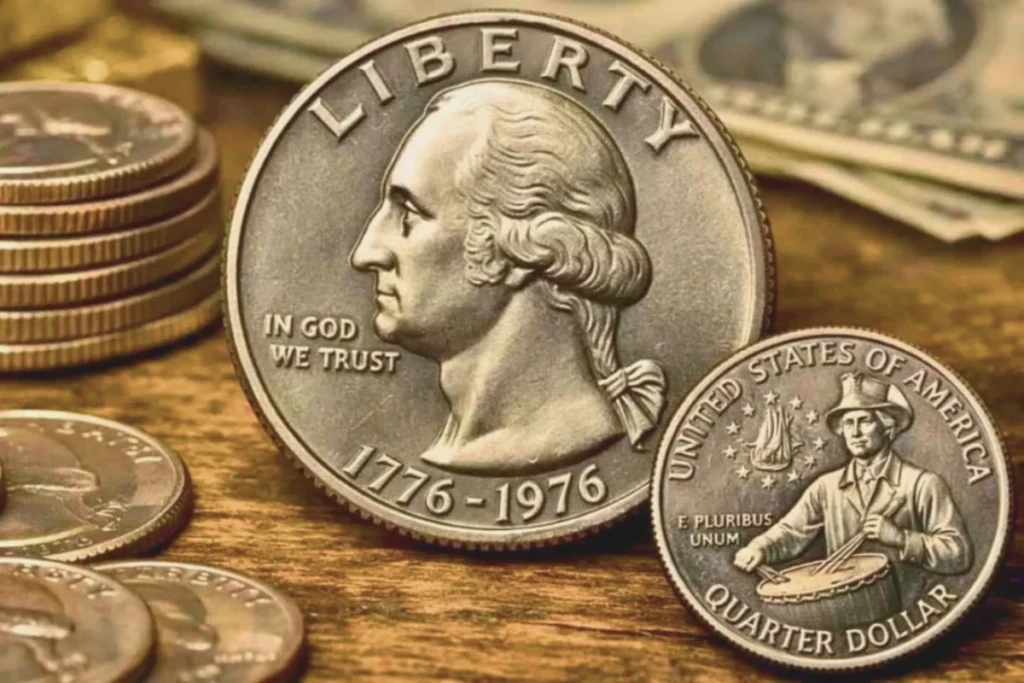
The Bicentennial Quarter 1776–1976 Value Guide begins with an understanding of the historical significance of this commemorative coin. The United States Mint issued the Bicentennial Quarter to celebrate the 200th anniversary of American independence. Instead of the standard eagle design used on regular quarters, the reverse side of this special coin features a colonial drummer accompanied by a torch encircled by thirteen stars; these stars represent the original thirteen colonies.
Production of these coins began in 1975 and continued through 1976; interestingly, however, no quarters bore the date 1975. All Bicentennial Quarters are inscribed with the dual date “1776–1976,” symbolizing the nation’s bicentennial celebration. During the year of the festivities, millions of Americans collected these coins as keepsakes, which is why many of them remain in circulation and in private collections to this day.
The Coin’s Unique Design
The design of the Bicentennial Quarter differs significantly from the traditional Washington Quarter that Americans had been using for decades. The obverse side of the coin still features the portrait of George Washington—originally designed by John Flanagan—thereby maintaining continuity with previous American quarters. However, the reverse side of the coin features a patriotic image created by artist Jack L. Ahr.
The design of the “Drummer Boy” was selected through a nationwide competition organized by the U.S. Mint. This design symbolized the spirit of the American Revolution and the unity of the early colonies. The inscription “United States of America” appears above the image, while “Quarter Dollar” is inscribed below it; these words frame the celebratory design, making the coin instantly recognizable.
Mint Production Data
The production of the Bicentennial Quarter was undertaken by the U.S. Minting took place at three distinct locations: Philadelphia, Denver, and San Francisco. Each mint produced coins with slightly different characteristics, which can influence a coin’s value depending on its condition and rarity. Coins minted in Philadelphia bear no mint mark, whereas coins from Denver are marked with a “D,” and those from San Francisco with an “S.”
San Francisco also produced special ‘Proof’ and silver editions, which were intended primarily for coin collectors rather than for general circulation. The surfaces of these editions are often mirror-like in finish, and they were sold in special commemorative sets. Due to their superior quality and lower production numbers, these coins frequently command higher prices in the collectors’ market.

Coin Mintage Table
| Mint Location | Mint Mark | Mintage Quantity | Metal Composition |
|---|---|---|---|
| Philadelphia | None | 809,784,016 | Copper-Nickel Clad |
| Denver | D | 860,118,839 | Copper-Nickel Clad |
| San Francisco | S (Proof) | 7,059,099 | Copper-Nickel Proof |
| San Francisco | S (Silver) | 11,000,000 (approx.) | 40% Silver |
This production data illustrates just how common most of the Bicentennial quarters currently found in circulation are today. The sheer volume of coins minted in Philadelphia and Denver means that circulated examples generally hold little monetary value for collectors—unless, of course, they are in exceptional condition.
Current Market Value
The value of a Bicentennial quarter depends primarily on its condition, strike quality, and rarity. Most common copper-nickel quarters that have seen extensive circulation are typically worth no more than their face value—that is, twenty-five cents. Since billions of such coins were minted, they remain among the most common commemorative coins in American history.
However, coins that never entered circulation—or remain in “Mint State” (like-new) condition—can command a higher price among collectors. In pristine condition—graded MS65 or higher—a Bicentennial quarter can sell for several dollars. The “Proof” coins minted in San Francisco also fetch higher prices, as they were produced in limited quantities and feature superior production quality.
Value of the Silver Edition
One of the most intriguing versions of the Bicentennial quarter is the 40% silver edition, which was minted in San Francisco. These coins were produced specifically for collectors and were never intended for use in everyday transactions. They were sold as part of special “Mint Sets,” which also included half-dollar and dollar coins commemorating the Bicentennial year.
Because these silver coins contain precious metal, their value is influenced by both collector demand and the prevailing market price of silver. Even in average condition, these coins often sell for several dollars. Coins in exceptional grades, or unopened collector sets, can command significantly higher prices within the numismatic community, driven by collector demand.

Impact of Condition Grading
Coin collectors rely heavily on grading systems to assess the condition and determine the market value of coins. The most widely utilized grading standard is the “Sheldon Scale,” which ranges from 1 to 70. Bicentennial Quarters that have seen extensive circulation—and have consequently suffered significant wear—typically receive lower grades and, as a result, carry a lower monetary value.
Conversely, coins that feature pristine details, retain their original luster, and exhibit minimal surface blemishes may qualify for high “Mint State” grades. These high-grade coins are exceptionally rare, as the vast majority of Bicentennial Quarters were heavily utilized in everyday commercial transactions. Consequently, coins in near-perfect condition hold immense appeal for collectors focused on assembling high-quality numismatic sets.
Collector Demand Trends
Demand for Bicentennial Quarters tends to fluctuate, influenced by broader, ongoing trends within the field of numismatics. Many collectors are drawn to this coin due to its patriotic symbolism and its historical association with the United States’ Bicentennial celebration. For many Americans, the coin also holds sentimental value, having been in widespread circulation during the late 1970s.
Modern collectors often prioritize rare error varieties, silver editions, or high-grade specimens over standard circulating coins. Consequently, the market for Bicentennial Quarters places greater emphasis on a coin’s quality and rarity rather than merely on its age. Although this coin itself is not particularly old, its historical significance continues to consistently captivate new generations of collectors.
Rarity of Error Coins
Some Bicentennial quarters have become more valuable due to errors that occurred during the minting process. Errors can arise during coin production when the dies used to stamp the coins are not properly aligned, or when a flaw remains on the coin’s surface. Collectors actively seek out these unusual variations, as they are far rarer than standard coins.
Examples of such errors include “doubled die” errors, “off-center strikes,” and “missing clad layers” (where the coin’s outer layer is absent). These anomalies create distinct visual differences in the coin, setting them apart from—and making them more special than—coins found in general circulation. Depending on the severity of the error and the condition of the coin, such pieces can fetch significantly high prices at auctions and in private sales.
Long-Term Significance
The Bicentennial quarter remains one of the most recognizable commemorative coins in American history. Its patriotic imagery and the dual date inscribed upon it represent a unique moment when the nation celebrated two centuries of its independence. Due to their massive production volume, most of these coins remain readily available today.
Despite their common nature, Bicentennial quarters hold cultural and historical significance for both collectors and historians alike. This coin serves as a symbol of national celebration and serves as a reminder of the “American revolutionary spirit” that shaped the country’s early identity.