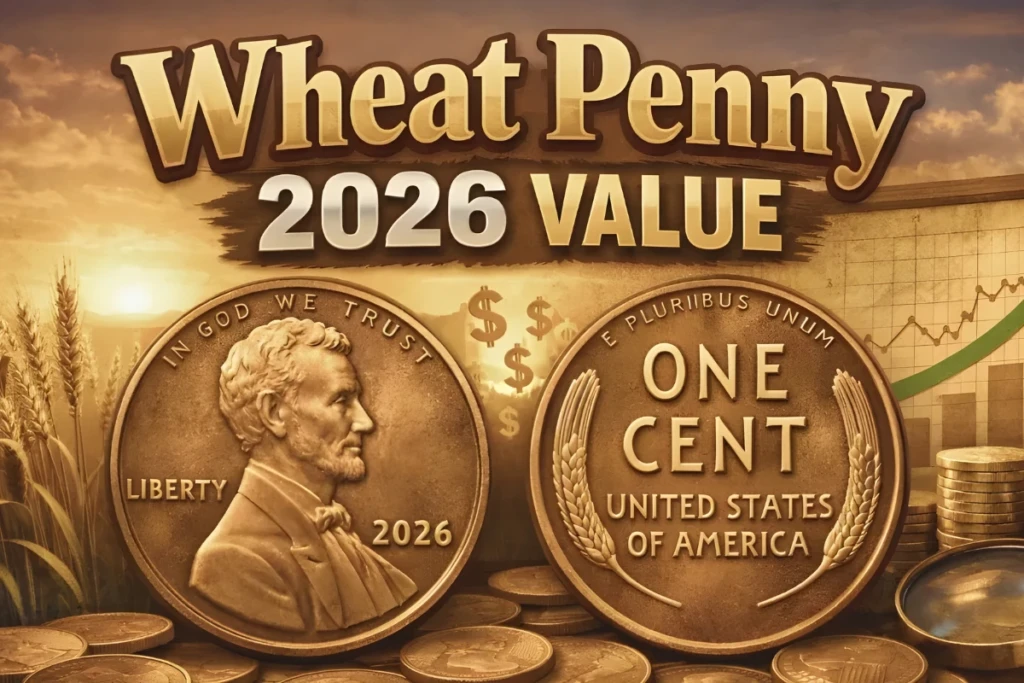
The 2026 Wheat Penny Value Guide begins with an exploration of the Lincoln Wheat Penny—one of the most easily recognizable coins in American history. These coins were minted in the United States between 1909 and 1958 and featured two stalks of wheat on their reverse side, earning them the nickname “Wheat Penny.” Designed by Victor David Brenner, it was the first American coin to feature the likeness of an actual historical figure—President Abraham Lincoln. To this day, coin collectors across America continue to study these pieces, as specific dates, mint marks, and errors can cause their value to far exceed their face value of one cent.
Historical Background
The Lincoln Wheat Penny was issued in 1909 to commemorate the centennial of Abraham Lincoln’s birth. This coin replaced the previously circulating Indian Head cent and marked a significant shift in American coinage design, initiating the practice of featuring a president’s likeness on circulating currency. The coin’s reverse side featured two stalks of wheat flanking the words “One Cent”; these stalks served as symbols of American agriculture and prosperity. Production of these coins continued until 1958, after which the wheat design was replaced by the Lincoln Memorial design starting in 1959.
Key Value Determinants
The value of a Wheat Penny depends on several measurable factors, including the year of issue, the mint mark, its rarity, and its physical condition. Coins that have seen extensive circulation may be worth only a few cents, whereas high-quality specimens—those retaining sharp details and their original copper luster—can command significantly higher prices. In many instances, collectors also assess the coin’s “mintage figure” (the total number of coins originally struck); This reveals how many coins were originally minted and how many of them survive to this day (i.e., how rare they are).
Condition and Grading
Coin grading (the classification of quality) plays a crucial role in determining the market value of a Wheat Penny. Professional grading services categorize coins into specific tiers, such as: Good, Fine, Very Fine, Extremely Fine, and Mint State. The higher a coin ranks within these categories, the sharper and more distinct the fine details of the Lincoln portrait on the obverse and the wheat ears on the reverse appear. Even a slight difference in grade can result in a significant fluctuation in a coin’s price—particularly in the case of “key dates,” of which very few specimens remain today.
Prices of Circulated Coins
Most Wheat Pennies found in circulation today are common-date coins that were minted in large quantities. Due to decades of handling and use, these coins typically exhibit signs of wear; consequently, they do not command a high price in the numismatic market. Nevertheless, they remain popular among hobbyists who enjoy assembling complete sets spanning various years and mints. Generally, depending on their overall condition and rarity, circulated coins sell for anywhere from a few cents to a few dollars.
The Rarity of Key Dates
Certain Wheat Pennies are designated as “key dates”; this signifies that they were minted in limited quantities or are difficult to find in good condition. These coins attract intense demand from collectors striving to complete a comprehensive collection of Lincoln Cents. For instance, the 1914-D penny is considered one of the most significant key dates, as it had a relatively low mintage and is rare to find in high grades. The prices of high-quality coins in the collector’s market can range from hundreds to thousands of dollars.
The Market for Error Coins
Minting errors are another major factor driving up the value of certain Wheat Pennies. Errors occur when a coin is not struck correctly during production; this results in unusual characteristics, such as doubled lettering, a missing mint mark, or an incorrect metal composition. Such errors are rare, as most defective coins were removed before entering circulation. When an error coin survives and its authenticity is verified, collectors often compete fiercely to acquire it due to its uniqueness and historical significance.
Famous Rare Examples
Certain Wheat Pennies have attained “legendary” status among coin collectors. The 1943 copper Wheat Penny is perhaps the most famous example, as pennies were supposed to be struck in steel that year during World War II. By mistake, only a handful of coins were struck using copper planchets, making them extremely rare and valuable. Some of these coins have sold for millions of dollars; depending on their condition, their value has reached figures well into the six or seven digits.
General Value Table
The table below presents estimated values for several popular varieties of Wheat Pennies, based on collector’s market projections for 2026.
| Year / Variety | Key Feature | Estimated Value Range (USD) |
|---|---|---|
| 1909-S VDB | Early issue with designer initials | $1,200 – $2,800+ |
| 1914-D | Low mintage key date | $1,800 – $14,000+ |
| 1922 No D | Missing mint mark error | $8,000 – $22,000+ |
| 1931-S | Scarce Great Depression issue | $900 – $4,500+ |
| 1943 Copper | Rare wartime mint error | $200,000 – $450,000+ |
These figures represent broad market estimates and may vary based on condition, certification, and auction demand.
Collector Demand Trends
Demand for Wheat Pennies remains robust, as they offer both historical significance and accessible opportunities for collecting. Many Americans begin their numismatic journey with these very pennies, as they are readily available—yet may harbor rare and unique specimens. The prospect of discovering a valuable coin in pocket change or an old jar continues to captivate both amateur enthusiasts and professional numismatists alike. In recent years, a resurgence of interest in collectible coins has also fueled increased activity in online trading and auctions.
Long-Term Value Outlook
The long-term value outlook for Wheat Pennies depends on factors such as rarity, condition, and collector interest. As more coins are permanently absorbed into private collections, the supply of high-quality specimens tends to diminish over time. This gradual reduction in the available supply can drive up the value of rare varieties. Since this series constitutes a significant chapter in American numismatic history, many experts believe that Wheat Pennies will remain popular collectibles for decades to come.