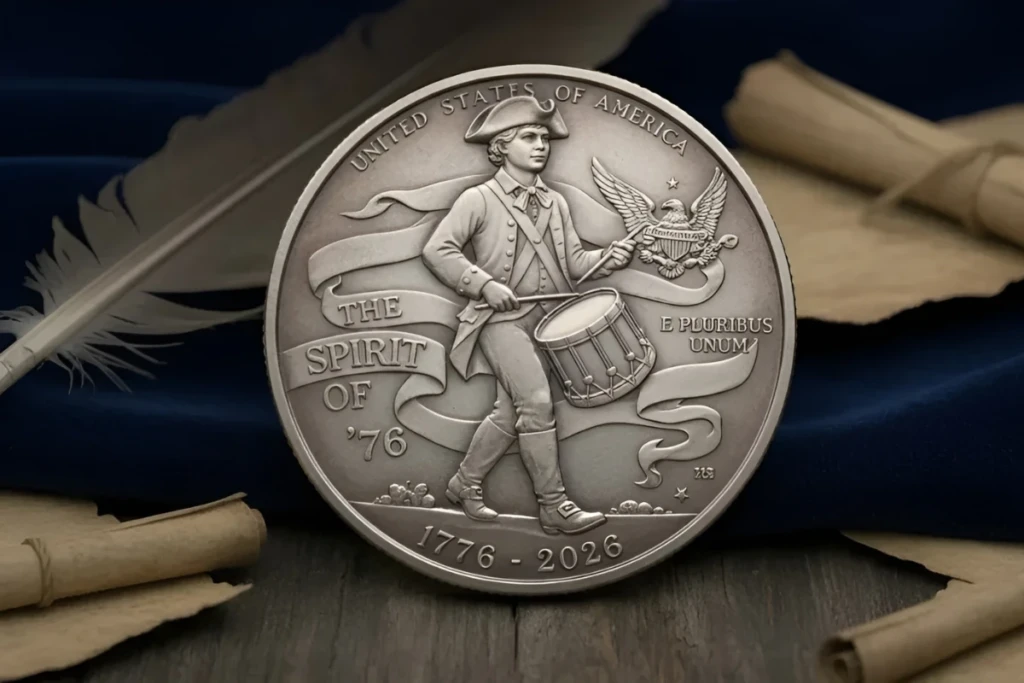
The 1976 Drummer Boy Quarter is one of the most well-known commemorative coins in American numismatic history. It is part of the Special Issue Bicentennial Quarters series, a category that appeals to collectors of all sizes, from casual hobbyists to high-grade specimens. Its distinctive reverse design and ease of availability make it a popular entry point into serious coin collecting.
This coin remains highly valuable in the market today. Demand remains steady at all grade levels, and premium specimens continue to attract competitive collector interest.
Coin Specifications
The 1976 Drummer Boy Quarter measures 24.3 millimeters in diameter and weighs 5.67 grams. The obverse features the familiar portrait of George Washington, while the reverse features Jack L. Ahr’s Colonial Drummer Boy design and a torch surrounded by thirteen stars. The obverse features a double date, 1776–1976, which immediately distinguishes it from the standard Washington quarter of the same era.
Standard quarter production readouts are on the edge. The overall design is clear and well-formed on all properly minted examples.
Metal Composition
The 1976 Drummer Boy quarter was produced in two different metal compositions, depending on the distribution channel. The standard circulation strike has a clad composition of 91.67% copper, with 8.33% nickel bonded to a pure copper core. The collector-targeted silver version contains 40% silver and 60% copper, offering a very distinct option for investors and advanced collectors.
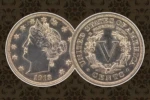
Examples with a silver composition command a significant premium over their clad counterparts. Identification of silver examples requires either weight verification at 5.75 grams or professional certification from a grading service.
Rarity and Demand
The 1976 Drummer Boy Quarter was minted in large numbers at the Philadelphia, Denver, and San Francisco facilities, making circulated examples readily available. However, surviving examples in full strike quality in Mint-State grades above MS-65 are very few. The San Francisco Proof Issue, especially those with the Deep Cameo designation, attract the most specialist demand.
Collector interest in the entire Bicentennial Coinage Set maintains consistent demand for this quarter. Registry competition for top-population examples keeps prices competitive at the highest grade levels throughout the year.
Minting Details
Three mint facilities produced the 1976 Drummer Boy Quarter, each with a different mintmark. The Philadelphia issue has no mintmark on the circulation strike, the Denver issue has a D, and San Francisco produced both proof clad and proof silver versions with an S mintmark. Strike quality varies from facility to facility, with some Philadelphia examples showing weakness in the fine details of the drummer boy.

San Francisco silver proof strikes generally have the sharpest overall detail and the most consistent quality. Collectors seeking top-grade examples generally prefer S-mint silver proofs for their superior production standards.
Condition and Grading
1976 Drummer Boy quarters are graded according to the standard Sheldon scale, ranging from Poor-1 to Mint State-70. Circulated examples grading between VG-8 and EF-40 are common and inexpensive, making it easier for new collectors to assemble a Bicentennial set. Mint-state examples grading MS-63 and above are gradually becoming less common and more desirable.
Full strike definition and uniform luster on both surfaces of the Drummer Boy instrument are key grading benchmarks. Professional certification from PCGS or NGC is strongly recommended for any example grading MS-65 or higher.
Market Value
The market value of 1976 Drummer Boy quarters varies significantly depending on composition, mintmark, and grade. Standard-clad circulation examples in good to excellent condition typically trade between $0.25 and $1. Mint-state clad examples graded MS-63 to MS-65 range from $5 to $35, depending on strike quality and attractive appearance.

Silver composition examples command a premium, with MS-65 examples fetching between $20 and $60. San Francisco silver proof quarters graded PR-69 deep cameos routinely fetch between $40 and $90, while perfect PR-70 examples can be found in the active collector market for $150 to over $300.
Investment Potential
The 1976 Drummer Boy Quarter offers a layered investment profile for collectors of varying budget levels. Clad examples offer an affordable entry point with modest upside, while Silver Composition issues offer genuine precious metal content as well as numismatic value. Top-grade Proof examples with Deep Cameo designations offer the longest-term upside potential in this series.
Growing collector interest in the entire Bicentennial Coinage Set supports consistent demand across all variants. Silver Proof examples in top-certified condition represent the most attractive investment tier, combining metal value with genuine scarcity at the most populous level.
Consequence
The 1976 Drummer Boy Quarter remains a highly collectible and highly sought-after issue in U.S. coinage. Its dual composition options, distinctive drummer boy reverse design, and value of over $300 in perfect certified condition make it an attractive target for both collectors and investors.
This coin’s widespread recognition ensures its continued demand across all collector generations. Whether purchased in clad or silver form, this quarter offers tremendous numismatic appeal and a clean investment that rewards grade-focused collectors with patience and market knowledge.