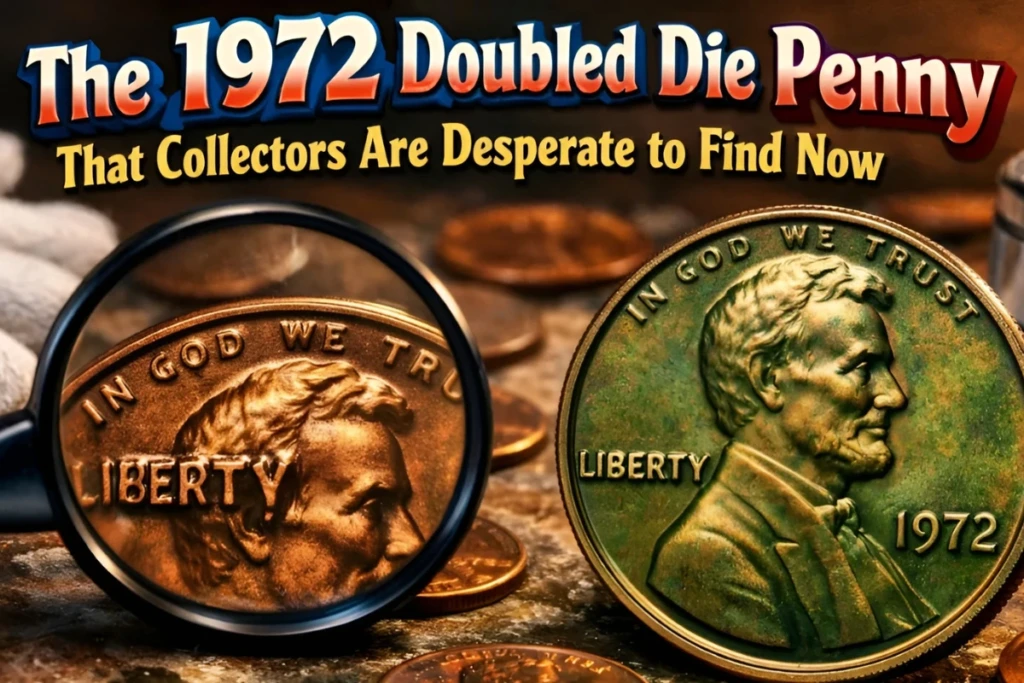
The 1972 Doubled Die Penny is one of the most famous modern coin varieties in United States numismatics. Collectors often recognize it by the strong doubling visible on the coin’s obverse design. This doubling occurs when the second impression on the coin’s die is incorrectly formed during production, resulting in duplicate letters and numbers.
Unlike minor mint errors, this variety is easily visible without magnification. Over the years, it has become popular with collectors as it serves as a clear example of how mechanical errors during minting can create rare and valuable coins.
Background to the Coin’s Minting
The 1972 Doubled Die Penny was minted at the Philadelphia Mint in the early 1970s. At that time, the United States Mint was producing large numbers of Lincoln cents to meet national demand for small change.
Coin dies were made using a hubbing process, in which the coin’s design was impressed into the die. If the hub shifted slightly between impressions, the design could appear doubled. In 1972, this very situation produced one of the strongest doubled die varieties in circulation.
Visible Details of the Doubling
What makes this coin unique is the striking doubling on the obverse. The word “LIBERTY,” the date “1972,” and the phrase “IN GOD WE TRUST” all show clear distinctions between the doubled images.
Unlike machine doubling, which often appears flat or shelf-like, the 1972 doubled die features rounded, fully formed duplicate letters. Because the effect is so strong, many collectors first noticed the coin while casually examining pocket notes.
Discovery and Identification
This variety was discovered shortly after the 1972 coins entered circulation. Numismatists and collectors immediately reported unique examples of Lincoln cents with clearly doubled letters.
Experts later confirmed that the coins came from a doubled die rather than a simple mechanical mint error. Once identified, the coin was listed in major reference guides, increasing awareness and demand among collectors throughout the United States.
Known Die Varieties
Several doubled die varieties have been identified for the 1972 Lincoln cent, but one stands out. Collectors commonly refer to it as “Type 1,” or the Major Doubled Die Variety.
This version exhibits extensive doubling that can be identified without special tools. Other minor varieties also exist, but they are much less dramatic and generally attract less attention in the collector community.
Presence in Circulation
Many examples of the 1972 doubled die penny originally circulated through everyday commerce. Because pennies were in common use in the 1970s, they passed through countless hands before collectors recognized their significance.
Because of this, surviving examples exist in a wide range of conditions. Some coins show heavy wear from years of use, while others were handled sparingly and are in near-uncirculated or mint state condition.
Interest in the Collector Market
Demand for the 1972 Doubled Die Penny has remained consistent for decades. Collectors appreciate it because the error is clearly visible, well-documented, and belongs to a widely collected coin series.
The Lincoln Cent series itself has long attracted collectors in the United States. When such a major error appears in such a well-known series, it naturally attracts attention and generates market interest for a long time.
Condition Value Variation
The value of this coin varies greatly depending on its physical condition. Coins that have circulated for many years may still have collector value, but high-grade examples often command significantly higher prices.
Professional grading services evaluate coins based on strike quality, surface protection, and wear. Coins with sharp details and minimal damage typically receive higher grades, which can impact collector demand and market price.
Historical Price Data
The market value of the 1972 Doubled Die Penny has changed over time as collecting trends and coin availability have changed. The table below shows approximate value ranges for different condition levels based on general collector market observations.
| Condition Grade | Typical Appearance | Estimated Market Range |
|---|---|---|
| Good (G-4) | Heavy wear, readable date | $150 – $250 |
| Fine (F-12) | Moderate wear, clear lettering | $250 – $400 |
| Extremely Fine (EF-40) | Light wear, strong details | $500 – $900 |
| About Uncirculated (AU-50) | Very light wear | $1,000 – $2,000 |
| Mint State (MS-65) | No wear, strong luster | $8,000 – $15,000+ |
These figures show how much a coin’s condition impacts its collector value. Even lower-grade coins are prized because the doubling is historically significant.
Design and Features
The coin features the classic Lincoln cent design by Victor David Brenner. The front of the coin features a portrait of Abraham Lincoln, along with the inscription “LIBERTY,” the date, and the national motto.

The reverse of the coin features the Lincoln Memorial, a design created in 1959 to commemorate Lincoln’s 150th birthday. The doubled-die effect is only applied to the obverse, leaving the reverse design unchanged.
The Importance of Authentication
Due to the coin’s popularity and value, authentication plays a significant role in the collector market. Some coins exhibit minor doublings that are mistaken for genuine doubled-die varieties.
Specialists examine the size of the letters, the spacing between the double images, and other minor features. Proper identification ensures that collectors and researchers can distinguish genuine examples from less significant forms of doubling.
Importance of the Coin
The 1972 Doubled Die Penny is one of the most recognizable mint varieties minted in the twentieth century. Its striking visual effect makes it an excellent educational example for collectors studying minting errors.
For many hobbyists, this coin represents the moment they first learned that everyday pocket money could contain rare and historically significant varieties. That sense of discovery continues to fuel interest in the coin even decades after its creation.